Athletes in any sport can be susceptible to mental health issues. Clinical depression, anxiety, various eating disorders, and personality disorders can all or in combination rise as problems for athletes. One of the most cherished aspects of being able to participate in a sport is to track and improve performance for an athlete. However, once an athlete acquires poor mental health, performance decreases greatly.
According to Tortora and Derrickson (2014), clinical depression, anxiety, eating, and personality disorders all have common emotional symptoms including:
- Constant feelings of helplessness and/or sadness
- Reduced ability to concentrate
- Excessive fear or anger
- Extreme feelings of guilt
- Mood swings
- Impulsiveness
- Detachment
- Withdrawal from friends and family
- Low energy and/or sleeping problems
- Changes in eating habits
Athletes facing state anxiety and small stressors from time to time are considered normal. Although, if the above listed symptoms become habitual, a mental disorder may be the cause. These symptoms as is cause normal individuals difficulty in being able to carry out daily functions. For athletes, these symptoms have a direct negative influence on performance on top of daily difficulties (Raglin, 2001). Additionally, prolonged emotional symptoms lead to somatisation. According to Weinberg and Gould (2015), somatisation is when a mental disorder continues for a prolonged duration and begins to cause physical symptoms including:
- Chest and back pains
- Dizziness
- Nausea
- Feeling of heart thumping (heart palpitations)
The physical symptoms evidently impact the athletes directly by resulting in a weakened immune system that hinders potential healing which in turn impairs overall performance.
The Mental Health Model of sport performance study (Morgan, 1985) outlined the decrease in athlete performance systemically. Psychological characteristics such as tension, depression, anger, vigor, fatigue, and confusion had a direct cause and effect relationship across several different sports. The fact that athletes of different sports had the similar negative psychological characteristics causing decreased performance emphasizes the increased feasible susceptibility of having a mental disorder as an athlete.
Numerous factors must be taken into consideration when evaluating the overall performance level of an athlete:
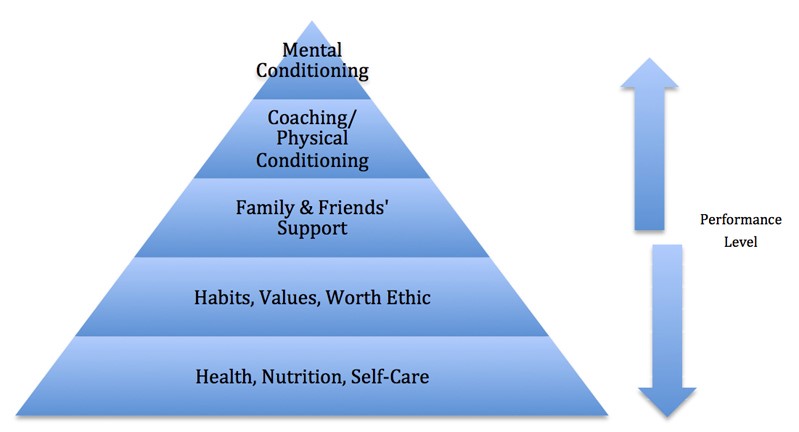
This pyramid highlights the importance of health, nutrition, and self-care as having the greatest quantity which leads to a high performance level. Mental disorders not only disintegrate this vital component but also begin chipping away at other factors (habits, work ethic, values, support system, and conditioning) which causes an overall highly decreased performance level.
The good mental health of an athlete is proportionally related to his or her success and high performance in that sport. Therefore, increased awareness and solutions to combat mental disorders faced by athletes should be implemented as part of available resources. This will ensure continued interest in sport as well improved overall health and fitness for the athlete.
References
Morgan, W. P. (1985) Selected psychological factors limiting performance: A mental health model. National Academy of Kinesiology, 70-80. Retrieved from http://www.nationalacademyofkinesiology.org/AcuCustom/Sitename/DAM/129/TAP_18_LimitsofHumanPerformance_08.pdf
Raglin, J. S. (2001). Psychological factors in sport performance. Sports Medicine, 31(12), 875–890. doi:10.2165/00007256-200131120-00004
Tortora, G. J., & Derrickson, B. (2014). Principles of Anatomy and Physiology (14th ed.). Hoboken, NJ: John Wiley.
Weinberg, R. S., & Gould, D. (2015). Foundations of Sport and Exercise Psychology (6th ed.). Champaign, IL: Human Kinetics.
 Mental Health IN SPORT